“Mimmo Paladino” exhibition at Villa Orsini
Vernissage – December 5, 7:00 p.m.
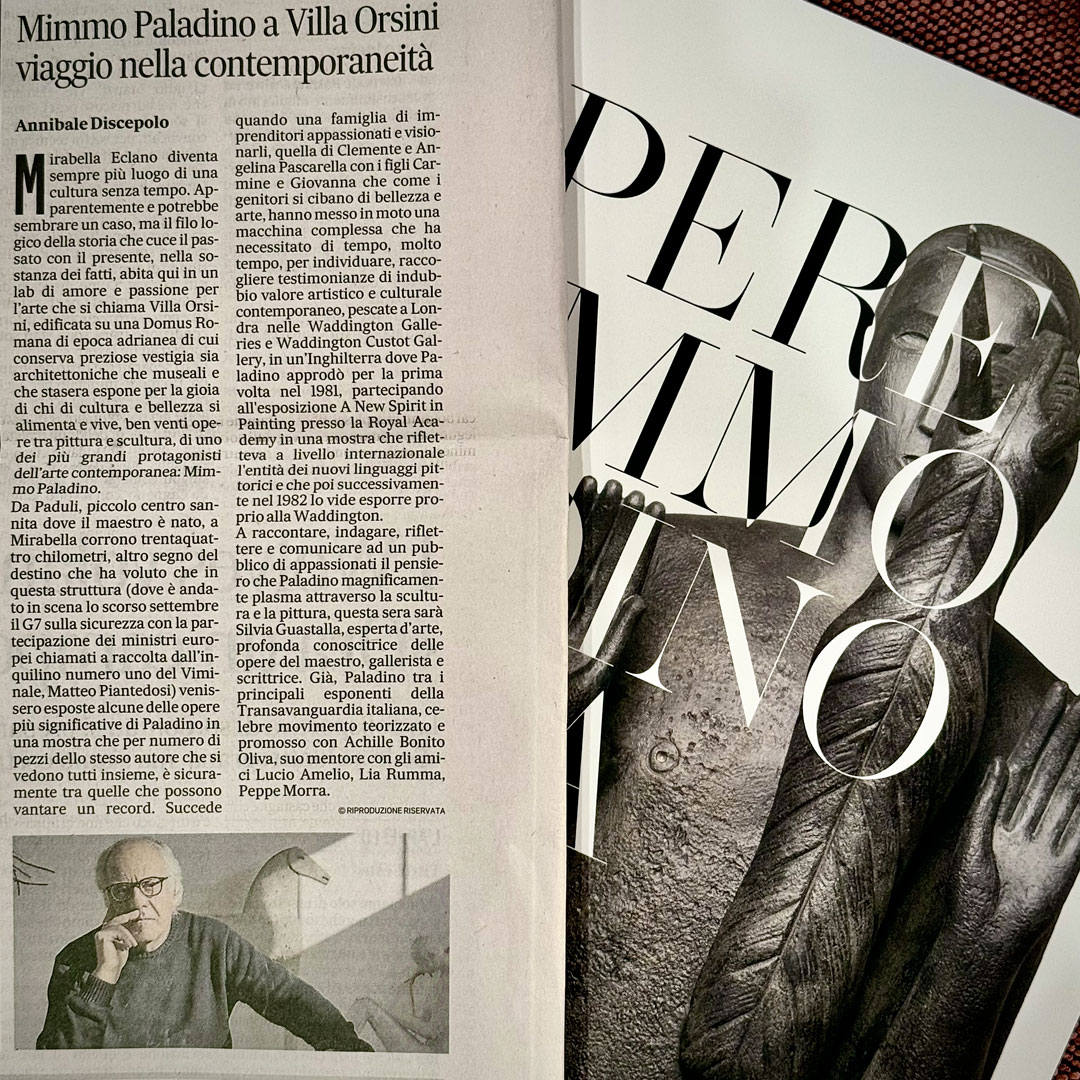
On December 5, Villa Orsini opened its halls and gardens to a new chapter in its history: an exhibition by Mimmo Paladino, an event that officially marks the debut of works by the master of the Transavantgarde on the estate, transforming the villa into a true journey through contemporary art—both outdoors and indoors.
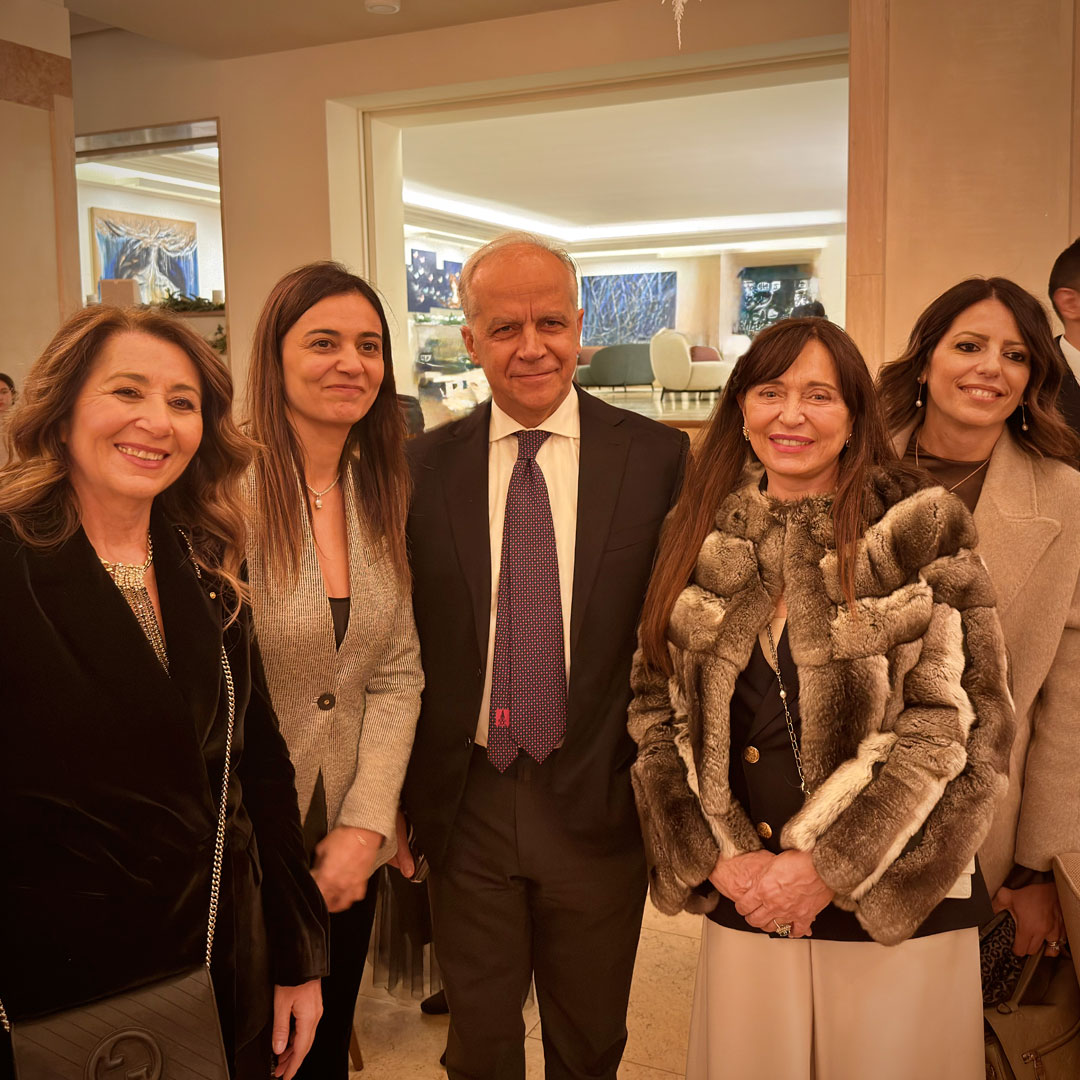
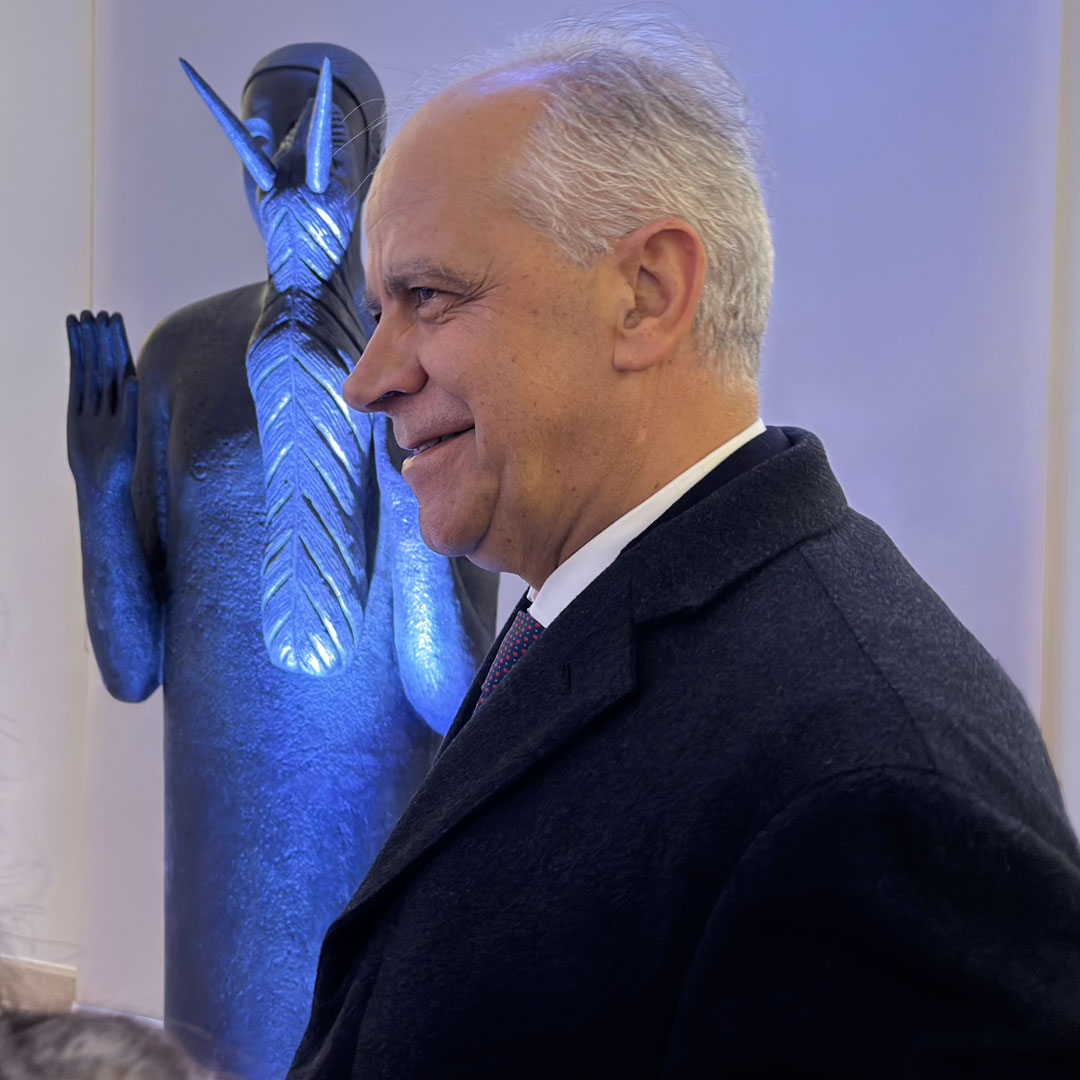
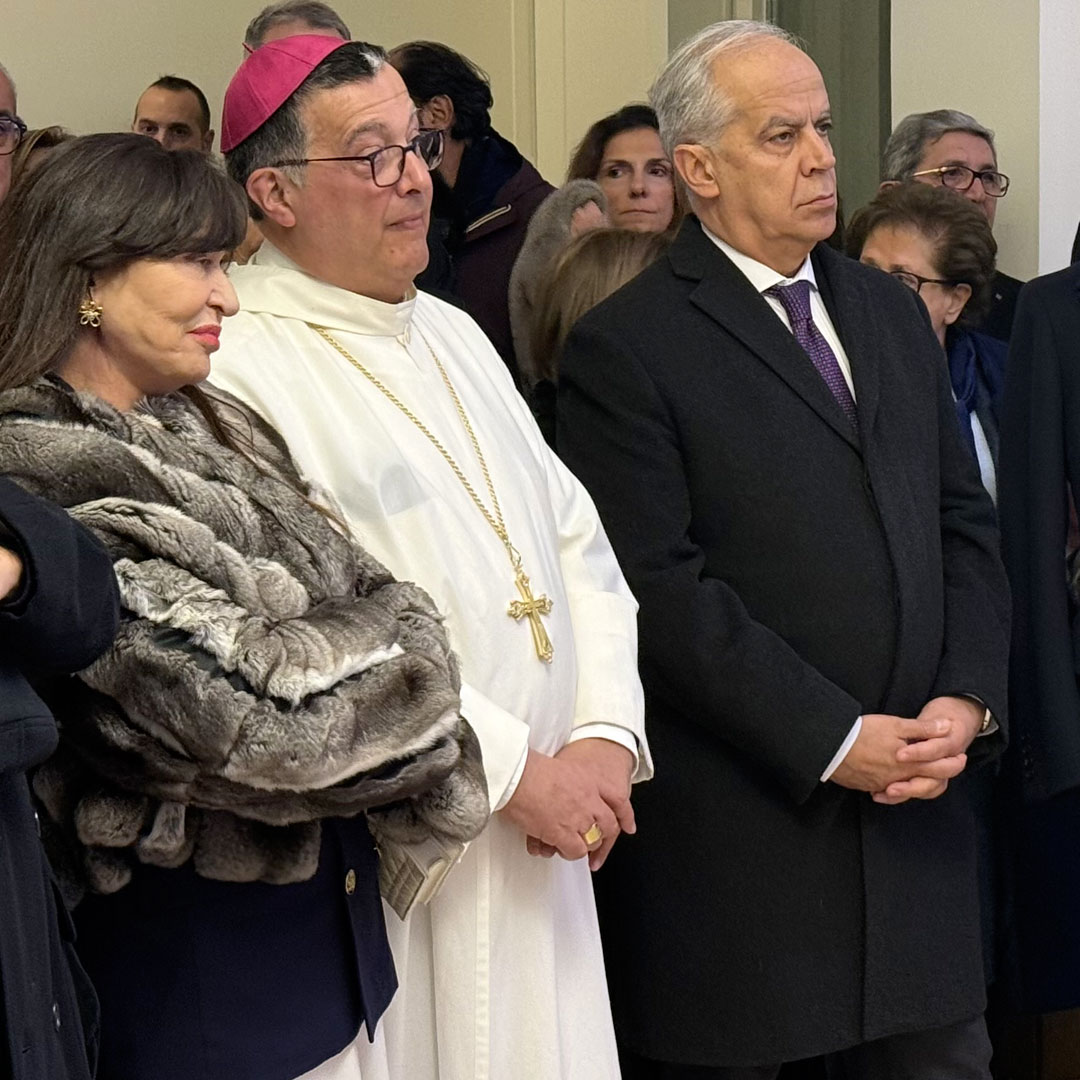
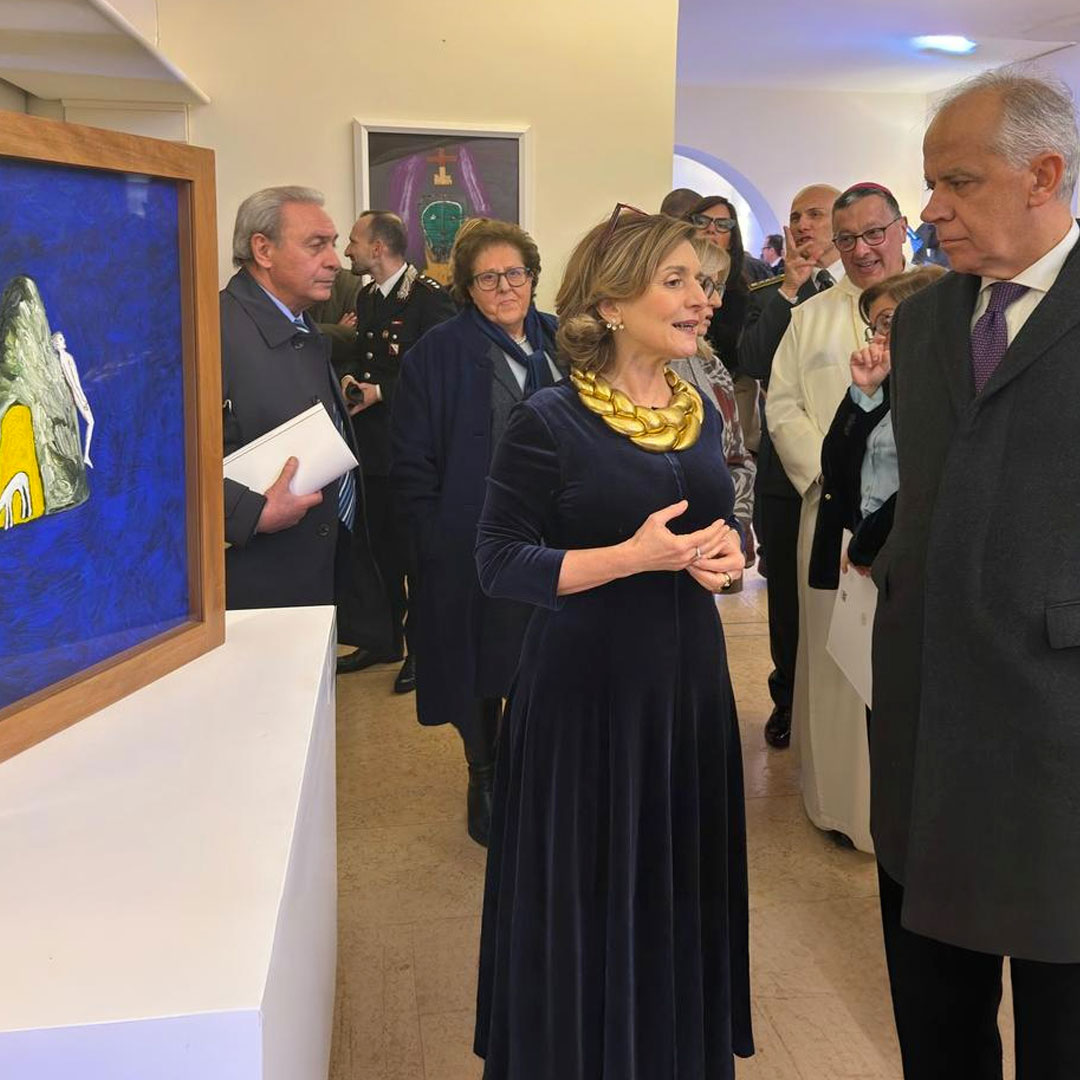
Just as with the major art events hosted here in the past—during which the villa successfully combined sculpture, painting, and haute cuisine into a single cultural experience—this exhibition, too, was conceived to foster a dialogue between creativity and the Irpinia landscape, featuring many distinguished guests, including the current Minister of the Interior, Matteo Piantedosi.
Mimmo Paladino: the voice of the south in the Transavantgarde
Domenico “Mimmo” Paladino, born in Paduli (Benevento) in 1948, is one of the leading figures of the Italian Transavantgarde, the movement theorised by Achille Bonito Oliva which, from the 1980s onwards, brought painting and the image back to the forefront following periods of more strictly conceptual art.
The following elements are constantly interwoven in his work:
- references to Greco-Roman, Etruscan and early Christian classical traditions;
- archaic symbols: masks, horses, totemic figures, enigmatic faces;
- deeply Mediterranean roots, linked to the landscape of the Sannio and Southern Italy.
Critics and scholars have often described Paladino as an ‘oak’ deeply rooted in his homeland: an artist capable of absorbing distant memories, myths and fragments of history, and transforming them into new, essential images, brimming with energy and mystery.
The exhibition at Villa Orsini: sculptures as presences, not as objects
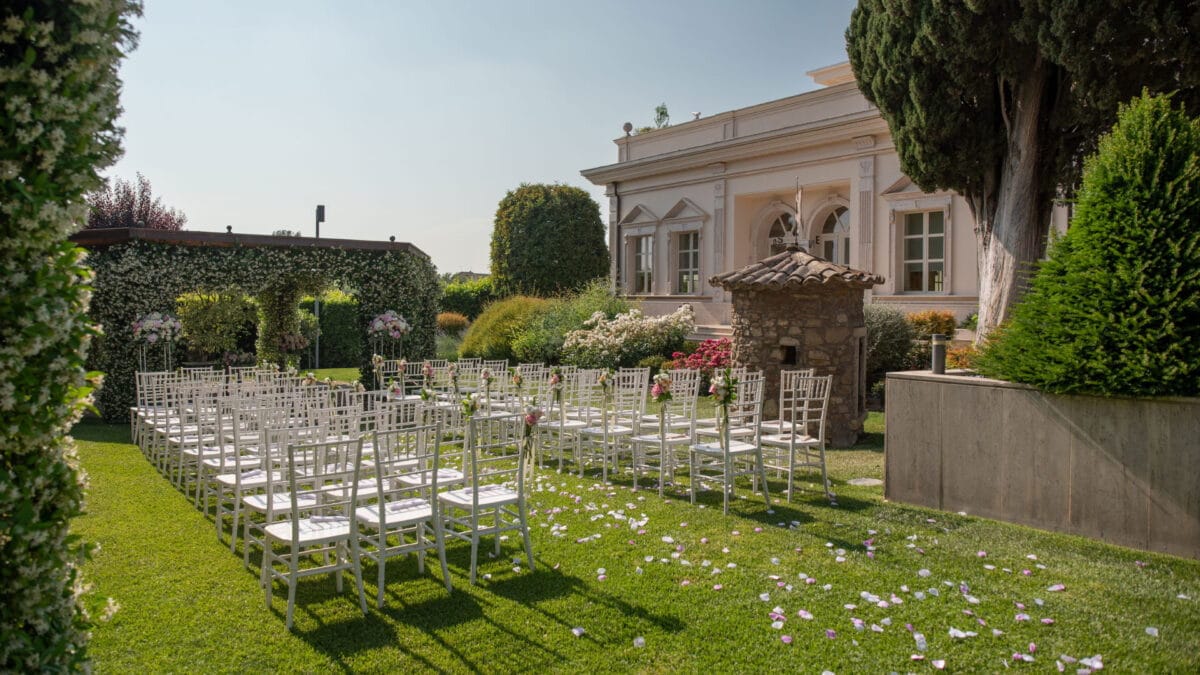
The exhibition at Villa Orsini stems from a specific concept: not simply to place works of art within an evocative setting, but to ensure that Paladino ‘inhabits’ the villa, both outside and inside, as if his sculptures were an integral part of the place.The residence – built on the site of a Roman domus dating from the time of Hadrian and reinterpreted in the 18th century by the Vanvitellian school – is, by its very nature, a meeting point between different eras. Historic architecture, the Irpinia landscape and contemporary art overlap, brush against one another and echo one another.In the large park, amongst the avenues, flowerbeds and views of the hills, Paladino’s sculptures almost blend in as if they were natural features:- Untitled (Three Spheres), 1989 – three large bronze spheres emerge from the lawn like ancient stones. Their metallic surfaces capture the daylight, reflecting it back in warm hues at sunset, and are veiled in soft shadows in the evening: they seem to emerge from a distant past, in dialogue with the greenery that surrounds them.
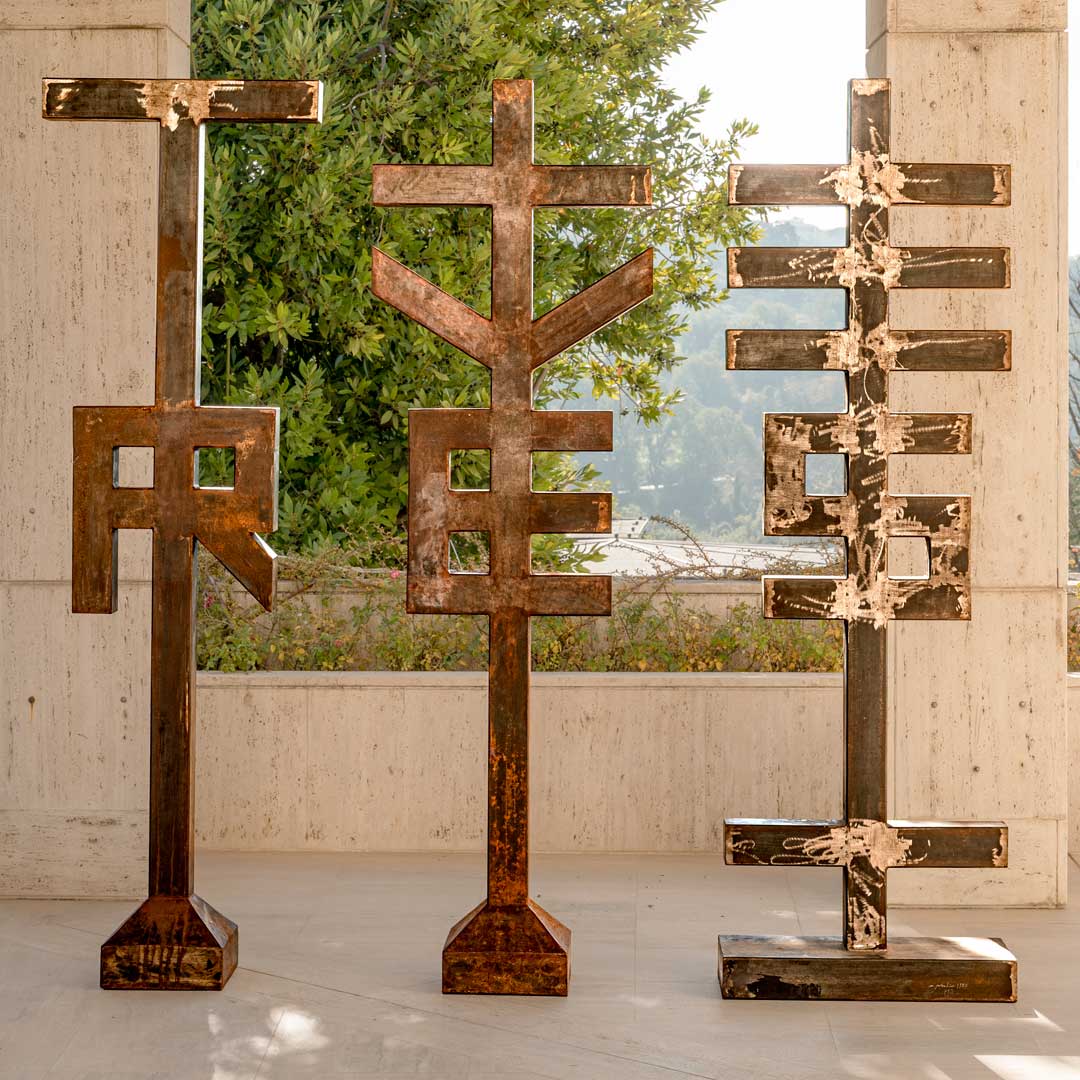
- Untitled (R.E.S. 1/2/3), 1987 – three vertical elements made of shaped steel, resembling crosses or mysterious alphabets, transform a portico into a veritable ‘place of signs’. The architectural structure becomes a stage for these subtle presences, halfway between totems and writing, as if an ancient language had materialised within the space.
Figures, masks, horses: the story told through the interiors
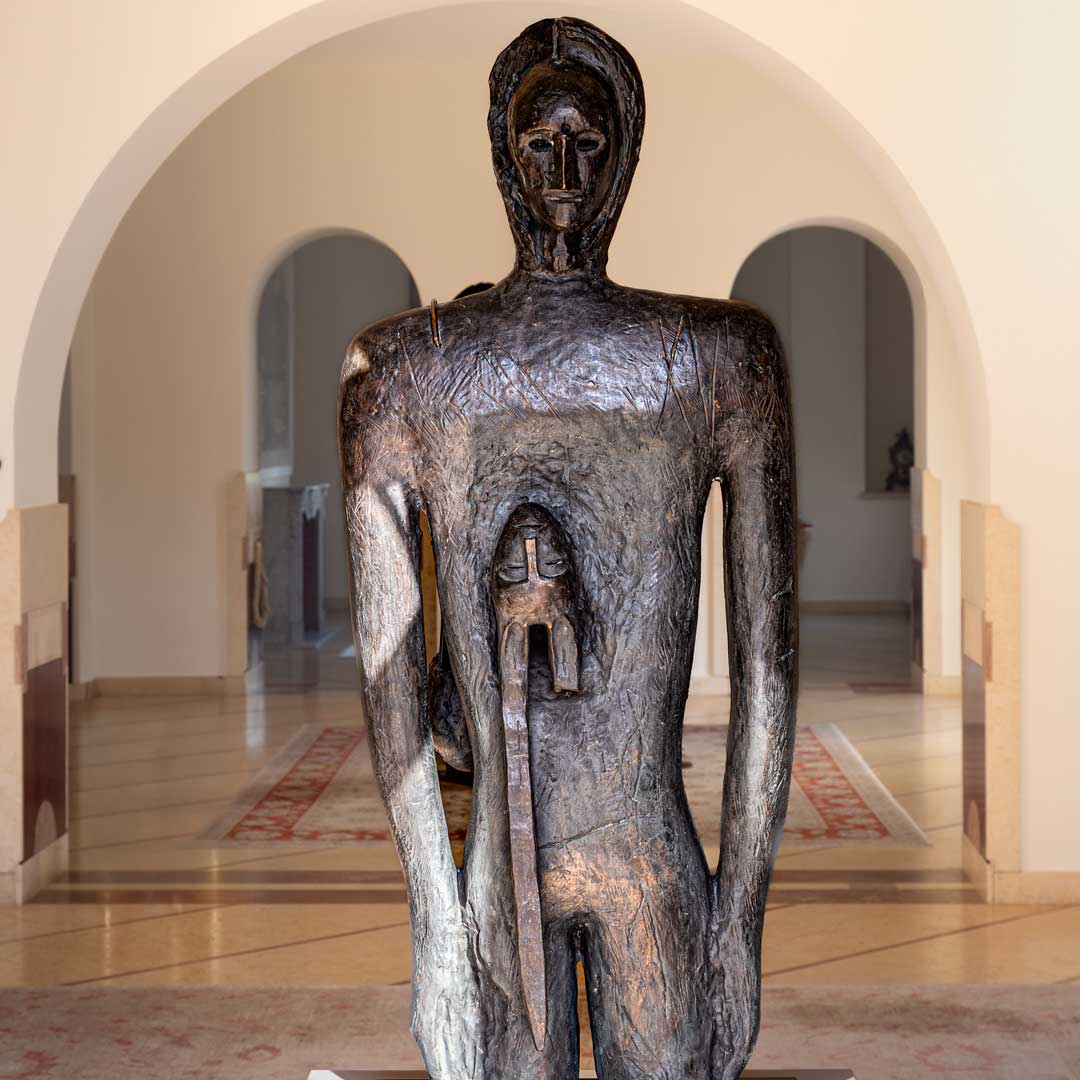
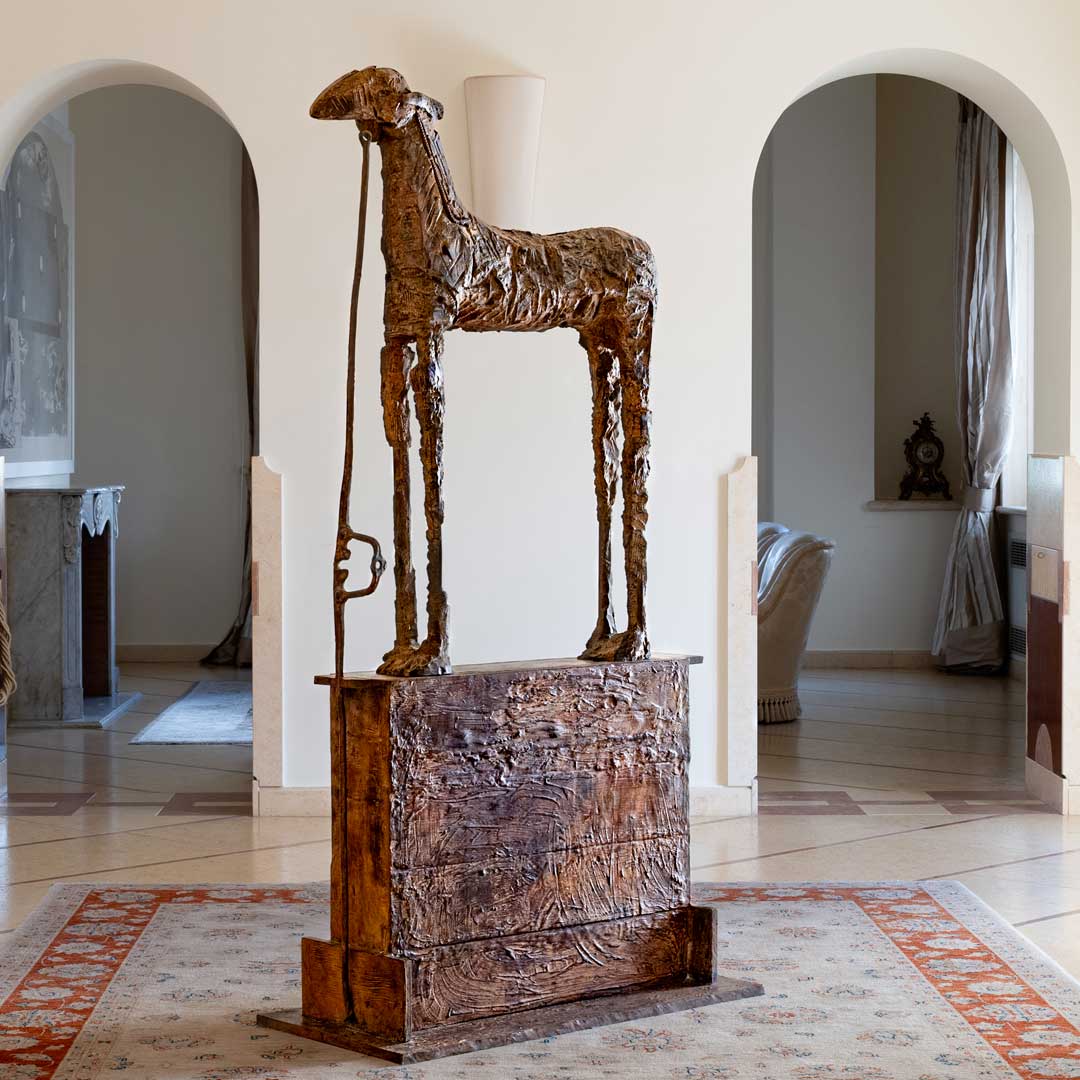
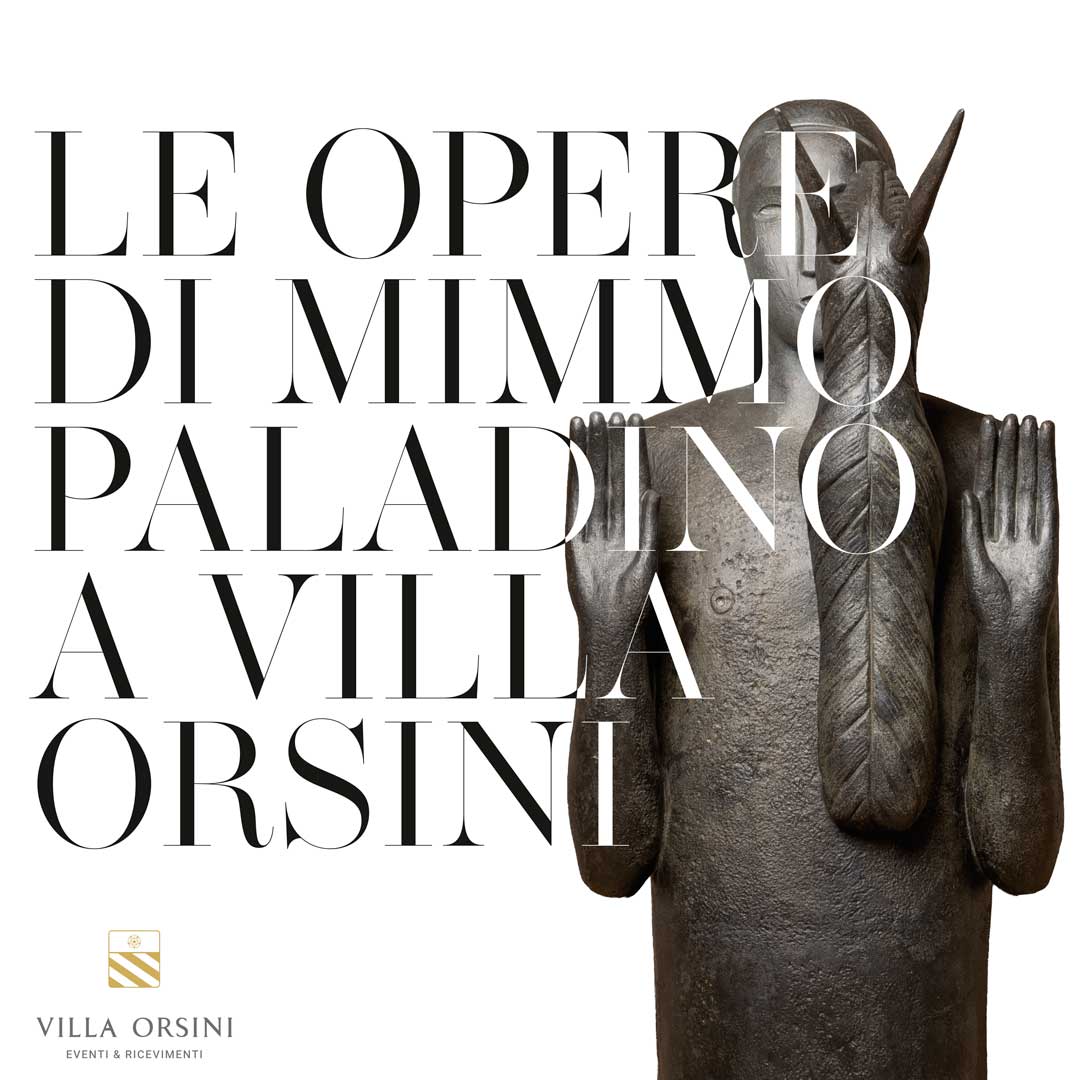
Inside Villa Orsini, the exhibition layout centres on a core of medium- and large-scale bronze sculptures, which occupy the halls, loggias and corridors, establishing a close dialogue with the arches, marble floors and perspective backdrops.Among the sculptural works, *Torso* (1993, bronze, 151 × 62.2 × 38 cm) represents one of the iconographic cornerstones of the exhibition: a totemic figure, standing perfectly upright, hollow at the centre, within which a second body is modelled. The ‘body-within-a-body’ concept visually embodies, in formal terms, the themes of generation, embodied memory and the stratification of time that run through Paladino’s entire body of work.Testimone (Figure with a Horned Animal) (1997, bronze, 168 × 58 × 55 cm) emphasises frontality and solemnity: the cylindrical torso, the raised hands, and the totemic animal leaning against the figure create an almost liturgical composition. The engravings on the back and arms refer to a system of ‘necessary’, non-ornamental signs that transform the surface into a sort of archaic script.Con Cavallo (2000, bronze, 218 × 103.5 × 50.5 cm), verticality is pushed to the limit: the animal, extremely elongated and devoid of any naturalistic detail, is set upon a compact, intricately worked plinth. The disproportionate relationship between the horse and the base, the slender legs and the highly textured patina accentuate the enigmatic nature of the subject and strip it of any vestiges of classical monumentality. The sculptural vocabulary is then articulated through a constellation of object-sculptures that explore the motifs of the house, the threshold, the bell and the head:- Untitled (House with a Golden Mask) (1992, bronze, 73.3 × 101 × 15.9 cm) features an architectural form reduced to its essentials, in which a cavity opens up from which a golden mask emerges. The mask functions as the point from which the face emerges – a threshold between the interior and the exterior.
- Fluid Dream (1985, bronze, 215.9 × 48.3 × 73.7 cm) evokes an almost ‘vegetal’ verticality, with a slender stem rising from a strongly projecting base, populated by semi-figurative forms: a flow of matter that coalesces into images only in fragments.
- Study for Sud II (The Door) (1993, bronze, 62 × 37.5 × 24 cm) and Untitled (Head and Doors on a Panel) (1993, bronze and steel, 200 × 60 × 34 cm) explore the theme of the door as a means of passage: panels and jambs feature figures in relief, heads, plant motifs and anthropomorphic elements; the doorway is both architectural and symbolic.
- Untitled (Cart with Bell) (1990, bronze, 43.5 × 33.3 × 14.6 cm) and Untitled (Head on a Pole) (1989, bronze, 194 × 42 × 76 cm) respectively place the motif of the bell and that of the archaic head on supports that emphasise their function as signals and ‘sentinels’ within the exhibition space.
- Untitled (1989, mixed media and collage on cardboard, 102 × 72 cm), in which a figure facing the viewer, with a green face, stands out against a solid colour scheme, defined by distinct areas;
- Tana (1993, oil on canvas in a wooden box, 67 × 57 × 8 cm), in which the painting is set within a containing structure, almost like a domestic reliquary;
- Untitled (1997, mixed media on panel with copper frame, 41.3 × 31.1 cm), in which the metal frame forms part of the composition;
- the series of large panels Alcaeus, Sappho, Solon, Ibycus, Anacreon (all 1990, mixed media, 218.5 × 157 × 157 cm), which projects onto the world of the Greek lyric poets a visual grammar composed of primary colour fields, outlines, and fragments of bodies and objects.
The catalogue: a guide to the exhibition
The exhibition is accompanied by a bilingual catalogue, in Italian and English, conceived as a critical tool rather than merely a photographic compendium. The volume opens with an essay by Silvia Guastalla, A Link in a Chain Connecting the Past to the Future, which precisely defines the interpretative framework within which Paladino’s presence at Villa Orsini should be situated.
The text focuses on three conceptual themes:
- Geographical and cultural context: Paladino is identified as an ‘artist of the South’, a product of a multi-layered Mediterranean heritage – ranging from the Etruscan and Greek worlds to the Lombards and Normans – in which the landscape is interwoven with ruins and archaeological remains. This dimension of a ‘veiled and mysterious South’ is cited as the primary source of his visual culture.
- Stratification as a method: the notion of stratification – walls built from ruins of different eras, fragments of Roman heads embedded in older blocks – becomes the key to understanding the coexistence of figuration, abstraction, decorative elements and minimal signs in the artist’s work. The image is understood as the emergence of a fragment from a profound visual process, in which the most arcane signs surface whilst the most obvious appearances recede into the background.
- Parallels between Villa Orsini and Paladino’s artistic vision: the villa, built on the site of a Roman domus dating from the Hadrianic period and rebuilt in the 18th century in the Vanvitellian style, is seen as a place where history and architecture have become intertwined, perfectly in keeping with the logic of a ‘collage of eras’ that underpins the artist’s work. From this perspective, the placement of the sculptures in the park is interpreted as the natural outcome of a process of mutual recognition between the site and the artwork.
For visitors to the opening, the book serves as a veritable ‘critical prosthesis’ for the exhibition: a reference guide for identifying techniques and dimensions, a collection of high-definition images and, at the same time, an interpretative essay that links the site’s past, Paladino’s visual biography and his current presence in the villa into a single narrative.
The vernissage: art, socialising, hospitality
To mark the exhibition opening, Villa Orsini welcomes guests, collectors, enthusiasts and cultural professionals to an event designed as a complete experience, rather than simply an exhibition opening.
The programme includes:
a warm welcome to the villa and gardens: the illuminated façade, the fountains in operation, the park serving as a natural gateway to the sculpture trail;
a presentation of the exhibition and the exhibition project, with an introductory segment focusing on Mimmo Paladino’s research and the relationship between his works and the history of the site;
a guided tour of the indoor and outdoor areas, offering a close-up view of the sculptures and works on wood, following the thread of recurring motifs – masks, doors, horses and symbolic figures;
a convivial occasion, in keeping with the finest traditions of Villa Orsini: tastings prepared by the villa’s chefs and glasses of local wines, selected from the villa’s historic cellars.
Following on from the previous ‘art evenings’, which transformed the residence into a veritable cultural salon featuring exhibitions and haute cuisine, the Mimmo Paladino vernissage promises to be an event where sight, thought and taste converge in a single experience.